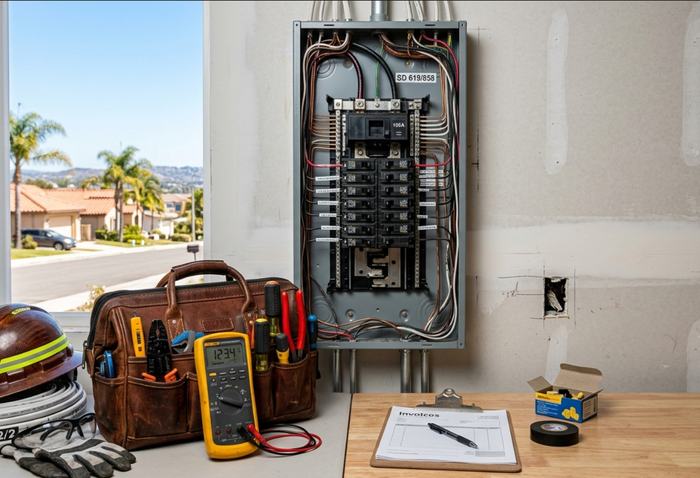
Electrical work has one of the widest price ranges of any home service, and for good reason: swapping an outlet and rewiring a 1960s house are both technically "electrical work," priced nothing alike. Here's what electrical jobs actually cost in San Diego in 2026, what's driving those numbers, and why it's taking a little longer than it used to for a licensed electrician to get back to you.
Why San Diego Electrical Work Costs What It Does
Electrical pricing here typically runs about 10 to 15 percent above the national average, driven by California's stricter code requirements, San Diego's overall cost of living, and steady demand for licensed electricians relative to how many are actually available. Add in that most jobs require a permit, and that permit fees and inspection scheduling are part of the timeline whether homeowners think about them upfront or not.
What Common Jobs Actually Cost
- Panel upgrade, 100A to 200A (the most common upgrade): typically $2,800 to $4,200.
- Panel upgrade, 200A to 400A (larger homes, ADUs, homes adding a heat pump or EV charger on top of existing load): typically $4,500 to $8,500.
- Panel replacement (damaged or failed panel, not a capacity upgrade): commonly $3,000 to $8,000, including labor, permit, and utility coordination.
- Whole-house rewiring: commonly $8,000 to $15,000 or more, depending on square footage and how accessible the existing wiring is.
- Permits: generally $150 to $400 depending on the city and scope, and not something to skip even for smaller panel work.
Smaller jobs, a new outlet, a ceiling fan install, a light fixture swap, usually get priced against a service call plus an hourly rate rather than a flat project fee, and most electricians apply the diagnostic or service-call fee toward the job if you move forward.
EV Charger Installation in 2026
This has become one of the more common electrical requests, and pricing depends heavily on one factor: the distance from your electrical panel to where the charger needs to go.
- NEMA 14-50 outlet only (using your own portable Level 2 charging cord): roughly $650 to $1,100.
- Hardwired Level 2 charger, panel and charger in the same general area: roughly $950 to $2,000.
- Longer runs through finished walls or an exterior weather-rated install: roughly $1,500 to $3,500.
- Add $2,800 to $4,200 on top of any of these if your panel also needs a capacity upgrade to support the new circuit.
Why Electricians Are Harder to Book Right Now
This isn't specific to any one company being disorganized. The U.S. Bureau of Labor Statistics projects roughly 81,000 electrician job openings per year through 2034, driven by a combination of retirements, rising demand tied to electrification (EV chargers, heat pumps, home battery systems), and an apprenticeship pipeline that takes years to produce a fully licensed electrician, so it can't respond quickly to a sudden jump in demand. A meaningful share of the current workforce is approaching retirement age, and the number of new electricians entering the trade hasn't kept pace. Practically, that means longer waits for a callback and less flexibility on scheduling, especially for smaller jobs that get slotted in around larger ones.
Frequently Asked Questions
How much does a basic electrical service call cost in San Diego?
Most electricians charge a service or diagnostic fee to come out and assess the job, which is commonly credited toward the repair if you proceed. Beyond that, small jobs are typically billed hourly rather than as a flat rate.
How much does a panel upgrade cost?
A standard 100A-to-200A upgrade, the most common request, typically runs $2,800 to $4,200. Larger 200A-to-400A upgrades for bigger homes or added loads like an ADU run $4,500 to $8,500.
Is whole-house rewiring really necessary, or can it be done in stages?
It depends on your home's condition and what's driving the request. Older homes with outdated wiring sometimes get rewired in phases as budget allows, though a licensed electrician is the right person to advise on whether partial rewiring makes sense for your specific situation versus doing it all at once.
Is the federal tax credit for EV chargers still available?
No, not as of this writing. The federal Section 30C credit expired June 30, 2026, and even while active, it only applied to homes in specific low-income or non-urban census tracts. Check directly with SDG&E for any current utility-level rebate.
Why does it seem harder to get an electrician to call back lately?
The trade is dealing with a real, well-documented labor shortage: the Bureau of Labor Statistics projects roughly 81,000 electrician job openings a year through 2034, driven mostly by retirements outpacing new workers entering the field. Longer callback times are a symptom of that, not a reflection of any individual company.
Do I need a permit for electrical work?
Most panel work, rewiring, and new circuit installations require one. Permits generally run $150 to $400 depending on the city and scope. A licensed electrician should factor this into their quote and pull it on your behalf.
Why do electrical bids sometimes vary so much for the same job?
Confirm each bid covers the same scope, panel capacity, and permit responsibility before comparing price alone. A lower bid that excludes the permit or assumes easier wire access than your home actually has isn't pricing the same job as a higher one that accounts for those realities.