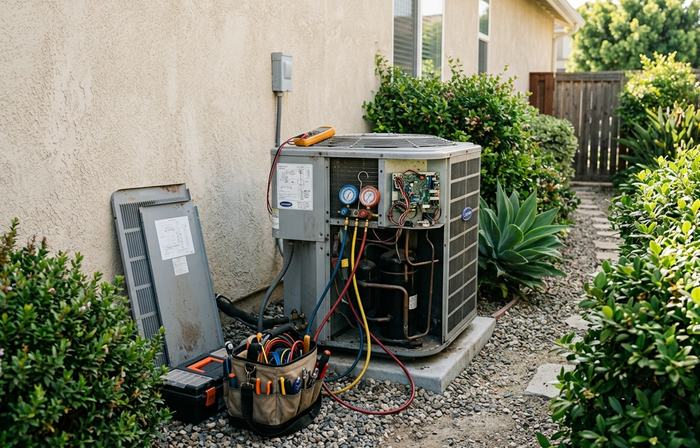
San Diego's climate is mild enough that plenty of homeowners run their HVAC system for fifteen or twenty years without much thought, right up until the day it doesn't turn on. At that point the range of quotes you get back can look almost random: one contractor says $400 fixes it, another says you need a full replacement north of $10,000. Both can be legitimate answers depending on the age and condition of your system. Here's what's actually driving HVAC pricing in San Diego this year, and how to tell which conversation you're really having.
What's Pushing Prices in 2026 Specifically
Two things are moving HVAC costs beyond ordinary inflation this year. California's updated 2026 energy code, Title 24, raised the minimum efficiency bar for new systems, generally requiring at least 15.2 SEER2 with 7.7 HSPF2 for heat pump heating, along with mandatory duct leakage testing on new installations. Higher-efficiency equipment costs more upfront, even if it saves on utility bills over time. Separately, tariffs on imported steel, aluminum, and copper have pushed up material costs across construction generally in 2026, and HVAC equipment, which relies heavily on all three metals, hasn't been insulated from that.
On top of both of those, San Diego is simply a higher-cost labor market than the national average. Local pricing typically runs somewhat above national benchmarks, largely because labor rates in the San Diego-Chula Vista-Carlsbad metro area sit well above the national median.
Full System Replacement
A complete HVAC replacement in San Diego, equipment, labor, permit fees, and disposal of the old unit, commonly runs $6,000 to $16,000 for a standard central AC or furnace swap, and can run $20,000 or more for larger homes, higher-end equipment, or systems requiring significant ductwork. Given the local labor market and the 2026 efficiency requirements, most homeowners here should expect a quote toward the upper half of that range rather than the low end, particularly for anything larger than a smaller single-story home.
A heat pump specifically, which handles both heating and cooling in one unit, typically runs $9,000 to $16,000 before any rebates for a typical residential system. If your ductwork is older or undersized for the new equipment, budget an additional $2,000 to $7,000 on top of the base installation figure.
What Rebates Still Apply in 2026
This changed meaningfully going into 2026. The federal Section 25C tax credit, which had offered up to $2,000 toward qualifying heat pump installations, expired for any equipment placed in service after December 31, 2025, eliminated under the One Big Beautiful Bill Act. If you're pricing a 2026 installation, that federal credit generally isn't part of the math anymore.
Locally, SDG&E's rebate programs are still active as of 2026, though program terms and funding levels shift over time, so it's worth confirming current amounts directly with SDG&E before counting on a specific number. As of this writing, the TECH Clean California program generally offers somewhere in the range of $1,000 to $6,000 toward a qualifying ducted heat pump depending on income tier, and SDG&E's separate equipment rebate adds a smaller amount, commonly cited as $200 to $500, for qualifying high-efficiency models. Income-qualifying households may also have access to federal HEAR program funds, which were distributed as state grants rather than tax credits and weren't affected by the 25C repeal.
Repair Costs
Most HVAC service calls start with a diagnostic fee, typically $75 to $250 depending on the company, which many contractors credit back toward the repair if you move forward. From there, routine repairs, a capacitor, a blown fuse, a refrigerant leak fix, generally run $150 to $600. Bigger-ticket repairs, most notably a compressor replacement, can run $1,500 to $3,000 or more. Straight labor, separate from parts, commonly runs $75 to $150 per hour, more for after-hours or emergency calls.
Repair or Replace?
There's a commonly used rule of thumb in the industry, not a strict formula, that if a repair estimate runs above roughly half the cost of full replacement, or the system is already well past the midpoint of its typical 15-to-20-year lifespan, replacement usually pencils out better over time. It's a reasonable starting point for the conversation, not a rule to apply blindly. A relatively young system with one failed part is usually still worth repairing. An aging system on its second or third major repair in a few years is the more common case where replacement quotes start making more sense to collect.
Getting Bids That Actually Compare
Because so much of an HVAC quote depends on details, system size, SEER2 rating, ductwork condition, whether permits and duct testing are included, an apples-to-apples comparison depends on giving every contractor the same information upfront rather than a vague "AC isn't working, need a quote." Posting one detailed description and getting a few bids against it, instead of describing your system slightly differently on separate calls, is the more reliable way to see what the real price range actually looks like for your specific home.
Frequently Asked Questions
What's a typical price range for a full HVAC replacement in San Diego?
Most standard replacements run $6,000 to $16,000, with larger homes, higher-end equipment, or significant ductwork work pushing past $20,000. Given local labor costs and 2026's efficiency requirements, expect the upper half of that range for anything beyond a smaller single-story home.
Is the federal tax credit for heat pumps still available in 2026?
No. The federal Section 25C credit expired for equipment installed after December 31, 2025. If you're pricing a 2026 installation, that specific credit is no longer part of the calculation, though state and utility rebates through SDG&E may still apply.
How much does a basic HVAC repair cost?
Routine repairs generally run $150 to $600 plus a diagnostic fee of roughly $75 to $250. Major repairs, particularly compressor replacement, can run $1,500 to $3,000 or more.
How do I know if I should repair or replace my system?
A commonly used starting point is comparing the repair cost to roughly half the cost of replacement, and factoring in the system's age relative to its typical 15-to-20-year lifespan. It's a reasonable rule of thumb, not a hard formula, and getting an actual quote for both options is more reliable than estimating on your own.
Why did Title 24 change HVAC pricing in 2026?
California's 2026 energy code update raised minimum efficiency requirements for new HVAC equipment and added mandatory duct leakage testing on new installations, which pushed baseline equipment and labor costs up compared to older code requirements.
Are SDG&E heat pump rebates still available?
Yes, as of 2026, though amounts and eligibility depend on income tier and program funding, which can change. Confirm current rebate amounts directly with SDG&E before finalizing your project budget.
Does a cheaper HVAC bid mean lower quality work?
Not necessarily, but it's worth confirming the bid covers the same SEER2 rating, duct testing, and actual square footage as your other quotes. A lower price that leaves one of those out is pricing a different job, not necessarily offering a better deal on the same one.