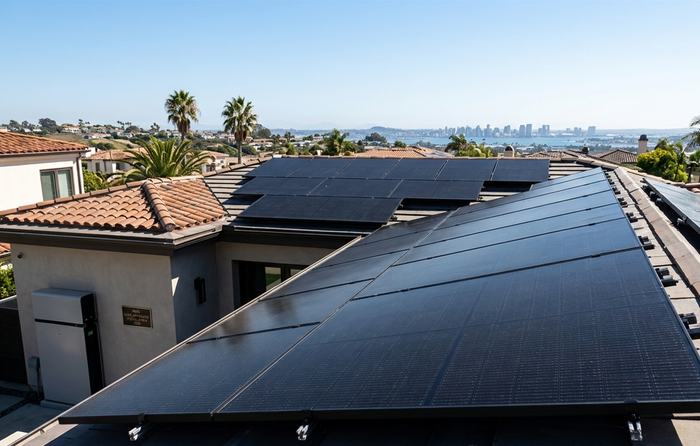
For years, "get 30% off with the federal tax credit" was the first thing every solar conversation in California led with. That's no longer true for most homeowners, and a fair amount of solar marketing hasn't caught up to it yet. Here's an honest look at what a system costs in San Diego in 2026, what actually happened to the tax credit, and why this market still has one real advantage most of the state doesn't.
What a System Costs Before Any Incentives
San Diego solar pricing in 2026 runs around $2.65 per watt installed. For a typical 6 to 8 kW residential system, the size that fits most single-family homes here, that works out to roughly $16,000 to $21,000 before any incentives, with larger or more complex installs running higher, up toward $28,000 for bigger systems or more difficult roof configurations.
The Tax Credit Change That Actually Matters
This is the part worth getting exactly right, because it's genuinely confusing right now, even in a lot of solar company marketing. The federal Residential Clean Energy Credit, Section 25D, offered a 30 percent credit for homeowners who bought their own solar system with cash or a loan. That credit ended for any homeowner-owned system installed after December 31, 2025, under the One Big Beautiful Bill Act. If you're buying and owning your system outright in 2026, that specific 30 percent federal credit is not part of your numbers anymore.
A separate credit, Section 48E, is still active, but it's a commercial credit, not a residential one. It applies when a company owns the solar equipment, which is exactly what happens with a solar lease or a power purchase agreement (PPA): the leasing company owns the system, claims the 48E credit itself, and can pass some of that value to you through a lower monthly payment. It's not a credit you claim directly, and it's not available at all if you purchase your system outright. Which ownership structure you choose changes which of these applies, so it's worth understanding the distinction before comparing offers, not after.
Why San Diego's Payback Period Still Beats Most of California
Here's the genuinely good news: San Diego has one of the fastest solar payback periods of any major utility territory in the state, commonly cited around 6 to 7 years for a cash purchase in 2026. That's almost entirely thanks to SDG&E's electricity rates, which run higher than most other California utilities, with a blended residential rate commonly cited around $0.47 per kilowatt-hour. Every kilowatt-hour a system generates and you use yourself offsets electricity you'd otherwise be paying SDG&E's above-average rate for, which is what makes the math work faster here than in most of the state, even without the federal credit.
What's changed is how that generation gets valued if you send it back to the grid instead of using it yourself. Under the state's current net billing structure, commonly called NEM 3.0, exported solar power is credited at a rate far below the retail rate you pay to buy electricity, roughly $0.08 per kilowatt-hour on average versus that $0.47 blended retail rate. That gap is exactly why battery storage has become a much bigger part of the conversation than it used to be: a battery lets you store your own solar production and use it yourself in the evening, instead of exporting it for a fraction of its value and buying it back later at full price.
Battery Storage and What's Left of SGIP
California's Self-Generation Incentive Program, SGIP, has historically been a major source of battery rebates. As of 2026, the broadly available version of that program has narrowed significantly. New SGIP applications are now largely limited to the Residential Solar and Storage Equity program, which is generally geared toward income-qualifying households and homes in disadvantaged or high wildfire-outage-risk areas, and much of that funding has already been reserved with new applicants placed on a waitlist. If battery incentives are a meaningful part of your decision, confirm current eligibility and funding status directly with your installer or SGIP's program administrator rather than assuming broad availability, since this has changed substantially from a few years ago.
Buy, Loan, or Lease?
Each path changes your numbers in a different way. Buying with cash gets you full ownership and the fastest long-term payback, but no federal tax credit under current law. A solar loan gets you ownership too, spread over time, generally at a higher total cost than cash once interest is factored in, but still no direct federal credit since you're the owner. A lease or PPA shifts ownership, and the 48E credit that comes with it, to the solar company, generally in exchange for a lower or no upfront cost and a fixed monthly payment, but you don't build equity in the system the way you would if you owned it. There's no universally right answer here, it depends on your upfront budget, how long you plan to stay in the home, and your own financial situation, and it's worth discussing directly with a few installers, and a tax professional if the ownership question is close, before deciding.
Getting Bids That Actually Compare
Solar quotes vary widely based on system size, panel and inverter brand, whether battery storage is included, and financing structure, which makes an apples-to-apples comparison genuinely difficult without a clear, consistent project description going to each installer. Posting the same details, roughly what size system you're considering, whether you want battery storage, and your ownership preference, to a few installers at once is a more reliable way to see real pricing than comparing quotes that were built around different assumptions from the start.
Frequently Asked Questions
Is the 30% federal solar tax credit still available in 2026?
Not for homeowners who buy and own their own system. That credit, Section 25D, ended for systems installed after December 31, 2025. A separate commercial credit still applies to solar leases and PPAs, where the leasing company, not the homeowner, claims it.
What does a typical solar system cost in San Diego right now?
Around $2.65 per watt installed in 2026, which works out to roughly $16,000 to $21,000 for a typical 6 to 8 kW residential system before any incentives, more for larger or more complex installs.
Is solar still worth it in San Diego without the federal tax credit?
San Diego has one of the fastest solar payback periods in California, commonly cited around 6 to 7 years for a cash purchase, largely because SDG&E's electricity rates run higher than most other utilities in the state. Whether it's worth it for your specific situation depends on your usage, roof, and how long you plan to stay in the home.
What is NEM 3.0 and how does it affect solar value?
It's the current net billing structure for exported solar power, which credits electricity sent back to the grid at a much lower rate, commonly cited around $0.08 per kilowatt-hour, than the roughly $0.47 per kilowatt-hour SDG&E charges to buy electricity. It's part of why battery storage has become more central to solar planning than it used to be.
Are battery rebates still available in California?
The broadly available version of the SGIP battery rebate program has narrowed significantly as of 2026 and is now largely limited to income-qualifying or high-wildfire-risk households, with much of that funding already reserved. Confirm current eligibility directly rather than assuming general availability.
Should I buy, finance, or lease solar?
Each has different tradeoffs: buying (cash or loan) means full ownership and faster long-term payback but no federal credit under current law, while a lease or PPA shifts ownership and its associated commercial tax credit to the solar company in exchange for lower upfront cost. It's worth discussing your specific situation with a few installers, and a tax professional if the decision is close.
Why do solar quotes vary so much between installers?
System size, equipment brand, battery inclusion, and financing structure all affect price significantly. Getting the same project details in front of multiple installers at once produces bids that are actually comparable, rather than quotes built around different assumptions.